Showing posts with label planets. Show all posts

Monday, February 18, 2013

This Day in History February 18, 1930

PLUTO PLANET

Although Pluto has been reclassified and no longer is called a planet, it was on this date in 1930, that Percival Lowell discovered the mysterious "Planet X."  It had been suspected by this scientist for a decades, but it was finally observed on this date in an observatory in Arizona.  

A survey went out requesting a name for this new planet, and it was and 11-year-old girl in England who proposed the name "Pluto."  Although there was no reason behind the name, it stuck if for no other reason than it had the initials "P-L" which referred back to the scientist who discovered it.

Once my daughter began going to school, I discovered that this was no longer a planet, and that seemed so strange.  When you have grown up with the idea of nine planets and now were down to eight, it just has never seemed right.  And I have heard that one day, it may be reclassified yet again as a planet, and this would be even more difficult to understand.  As far as I'm concerned, just call it a planet and have done with it!

For more information:

Thursday, September 22, 2011

This Day in History September 23, 1846

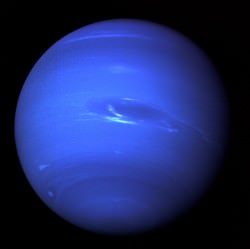
My daughter would think this was a really cool blog post.  It is about one of her favorite topics--astronomy.  On this day in 1846, Neptune (pictured above) was discovered by German astronomer Johann Gottfried
Galle at the Berlin observatory.  Earlier that evening, French astronomer Le Verrier was able to determine that an eighth planet did exist and where it might be (he was studying the disturbances in the motion of the planet Uranus).  He shared this information with Galle, and it was that same evening that Galle and his assistant discovered it.  It was proven to be a planet as it was watched closely over the next 24 hours.


Neptune is the eighth planet from the sun, has a diameter four times that of the earth, and it was named for the Roman god of the sea--Neptune (it is a blue gas giant!). It has eight known moons (hopefully this information is accurate as of today), and Triton is the largest.  It is also a planet with rings--three bright and two dim.  It orbits the sun once every 165 years. In 1989, Voyager II became the first human spacecraft to visit Neptune.

I would love to fill this space will all sorts of facts, but instead, I will leave you a couple links to check out:
http://www.universetoday.com/21581/neptune/
http://www.history.com/this-day-in-history/eighth-planet-discovered

You will also note that I have included an infographic.  They are the wave of the future, and I was pleased to find one that talked about the known universe.  Enjoy!

via
Related Posts Plugin for WordPress, Blogger...
Your Ad Here