Showing posts with label London. Show all posts

Tuesday, January 1, 2013

This Day in History January 1, 1772

By Valentin Wittich (Kodak DX7590) [GFDL (http://www.gnu.org/copyleft/fdl.html) or CC-BY-SA-3.0 (http://creativecommons.org/licenses/by-sa/3.0/)], via Wikimedia Commons
Think about travelers from way back when who had no credit cards or ATM's.  Money would have been a big issue.  And the London Credit Exchange came up with something that could help this problem on this date in 1772.  The first traveler's cheques were issued, and these were much more difficult for thieves to convert to cash.  It was not until the 1890's that American Express started issuing these, but London started the process.  Interestingly enough, they never gained the popularity you would have expected.

For more information:
http://en.wikipedia.org/wiki/Traveler%27s_cheque
http://www.kesq.com/news/-/233092/17937020/-/displayReplay/true/displaySharing/true/endCapDisplay/false/leadLimitToHeight/360/leadLimitToWidth/640/numVisibleSlides/4/offset/2/res/medium/-/c5ygeaz/-/index.html
http://famousdaily.com/history/london-issues-travelers-cheques.html

Wednesday, October 10, 2012

This Day in History October 10, 1971

By Ken Lund from Las Vegas, Nevada, USA [CC-BY-SA-2.0 (http://creativecommons.org/licenses/by-sa/2.0)], via Wikimedia Commons
All right, I certainly learned something quite interesting.  Did you know that we have a piece of London history in Arizona? I honestly did not.  Here's the story.  The original London Bridge was constructed in 1831, and it was built over the Thames River.  In 1962, the bridge was deemed structurally unsound.  The City of London sold this bridge to Rober McCulloch, founder of Lake Havasu in Arizona.  The bridge was carefully dismantled, and it was sent to Arizona.  It was reconstructed, and on this date in 1971, it was officially dedicated.

For more information, please check out:
http://encyclopedia2.thefreedictionary.com/London+Bridge+Days
http://www.placesearth.com/usa/arizona/mohave/london_bridge/london_bridge.shtml
http://www.flickr.com/photos/75683070@N00/3227888290/
http://www.thepeoplehistory.com/october10th.html

Sunday, December 4, 2011

This Day in History December 5, 1952

What a great tragedy this was, and it is fairly recent as far as history goes.  It was on this day in 1952 when the greatest smog disaster in London occurred.  Granted, it wasn't only on this day, and depending on the account one reads, one may find it began on the December 4, but it certainly lasted longer than the 5th.

Leading up to this event, the weather in England of late 1952 had been unusually cold.  People were burning coal to stay warm, and there was a light fog that came about on late December 4/December 5, and it did not life.  No one really thought much about it.  It was just fog.  What they did not realize was all the harmful smoke and sulfur dioxide that were in the air--5 to 6 times normal.

As the week went on, casualties occurred.  There were a few accidents due to the fog, but the main issue was respiratory/cardiovascular problems.  In fact, people would go to sleep and not wake up.  It is estimated that at least 4000 people died!  Most of these people were over 65 years old, but the infant mortality rate doubled during this week as well.

Following this great disaster (that lasted about a week), the authorities outlawed the use of coal, and they passed legislation to keep this from happening again.  Cars are, of course, a real nemesis, and the government is still trying to regulate air pollution from these vehicles.

Here are some sites that cover this disaster in greater depth:
http://english-magazine.org/index.php/sci-tech/913-science-article.html
http://barryrutherford.hubpages.com/hub/Th-London-Smog-of-1952
http://onlinelibrary.wiley.com/doi/10.1002/qj.49708034420/abstract
http://news.bbc.co.uk/2/hi/uk_news/england/2545759.stm

Thursday, September 1, 2011

This Day in History September 2, 1666

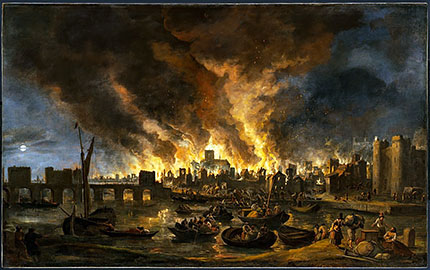
Today is the anniversary of the great fire in London.  This great fire began the night of September 2, 1666, as a small fire in the shop of King Charles II's baker.  A servant in the shop awoke at 1:00 A.M. to discover the fire, and though the baker and his family got out, the servant did not.

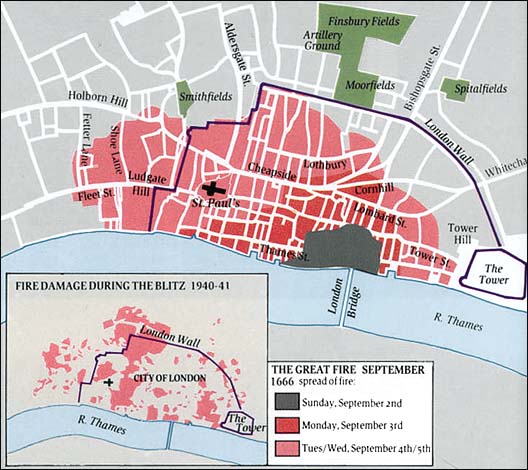
The fire spread quickly since the houses of London were made of wood and pitch. The strong winds that blew that night only made things worse.  Though the citizen fire brigade fought valiantly, by 8:00 A.M., the fire was halfway across the London Bridge.  In fact, the only thing that stopped the fire from spreading further across the bridge was the gap that had been caused by the fire of 1633.

Back then, standard procedure for stopping fires of this nature was to create fire breaks by destroying houses in the path of the fire.  Concern was raised that the cost of rebuilding might be too high, and unfortunately, the destruction of houses only pushed the fire onward.  For three days, the fire burned out of control with no relief in sight until it stopped near Temple Church.

Suddenly, it began again, and now Westminster was in danger.  The Duke of York ordered the Paper House to be demolished in order to create a fire break, and finally the fire was stopped once and for all.


Thankfully, the loss of life was minimal.  Some sources say 16, but I think others say 6 or even 4.  But this is not what staggered the city.  Four hundred thirty acres--about 80% of the main part of the city--were destroyed.  That includes 13,000 houses, 89 churches, and 52 Guild Halls (meeting place for craftsmen).  The only positive thing about this fire was the eradication of the plague of 1665.

Before the blaze, London had very narrow streets (I cannot imagine London having more narrow streets than it does now--I have been there!).  King Charles II commissioned a complete redesign of the city which included wider streets and buildings of brick.  By 1671, 9000 houses and public buildings were completed.  Then in 1675, work was begun on about 50 new churches.  There is even a commissioned monument which still on the site of the bakery where it all began.

It would seem that the fire was an accident, but since people wanted a scapegoat, the Catholics were blamed.  It was around 150 years later when the inscription that accused the Papacy of starting the fire was removed from the monument.

If you would like to see comparative pictures of the London skyline before and after the fire, click here.

Websites Used:

Related Posts Plugin for WordPress, Blogger...
Your Ad Here