Showing posts with label fire. Show all posts

Wednesday, November 28, 2012

This Day in History November 28, 1942

The Cocoanut Grove in Boston, MA was one of the most elegant nightclubs of its time.  During the summer, the roof could be electrically rolled back so that people could dance under the stars. On this date in 1942, some time after 10 P.M., a young couple wanted some privacy.  So they unscrewed a light bulb.  A 16-year-old busboy was instructed to replace the light, and so he lit a match so he could see what he was doing.  Shortly thereafter, a flame was spotted on the satin ceiling, and people were amused to try to see the waiters put the fire out with seltzer water.

The temperature was 28 degrees, and the air was dry.  A short ways away, firefighters were putting out flames in an automobile, and they saw smoke at the nightclub.  Eventually, 187 firefighters, 26 engine companies, five ladder companies, three rescue companies, and one water tower were used in the fighting of this fire.  Meanwhile, the fire was spreading quickly inside the club, but an employee insisted no one leave without paying their check.  Eventually, about 500 were killed in this tragedy.

For more information:
http://www.celebrateboston.com/disasters/cocoanut-grove-fire.htm
http://www.boston.com/news/daily/21/archives_cocoanut_112292.htm
http://en.wikipedia.org/wiki/Cocoanut_Grove_fire
http://www.infoplease.com/dayinhistory/Nov-28

Friday, October 7, 2011

This Day in History October 8, 1871

This was a tragedy that occurred on this day in 1871.  You've probably heard of the great Chicago fire.

This is the cow that probably did not start the fire.  Legend says that a cow in the O'Leary barn kicked over a lantern.  While we do not know for sure, no one really knows.  It had been a dry summer, and the buildings were made of wood and built close together.  It does seem that the fire began in  their barn, but it could have been humans (it would be like humans to blame a cow, wouldn't it?) or even a comet.   The fire did begin just after 9:00 P.M.  Fire was common in Chicago--it averaged two fires per day in 1870, and the week before the great fire saw 20 fires.

The fire itself last two days.  There was much devastation:

  • 200-300 people dead
  • 17,450 buildings desroyed
  • 100,000 people left homeless
  • $200 million dollars worth of damage ($3 billion in 2007 dollars)
Rain began to fall after two days of fire and devastation.  Amazingly, the city recovered very well.  Its water, transportation, and sewage systems had remained intact.  By 1893, Chicago was a major hub--the site of the World's Fair.  The population was 27.5 million by that point.

Interestingly enough, the Chicago City Council exonerated Mrs. O'Leary and her cow in 1997.  As you can imagine, Mrs. O'Leary became a recluse after the fire.  I'm sure that people blamed her for the fire, and she lost any friends she may have had.

I am so glad that these kind of fires do not seem to happen in this country any more.  We now have wildfires, and I know they are devastatiing.  But I cannot imagine what it must have been like to try to put out that fire back then.  It must have been so frightening.  Thank God I live where I do when I do!

For more information:

Thursday, September 1, 2011

This Day in History September 2, 1666

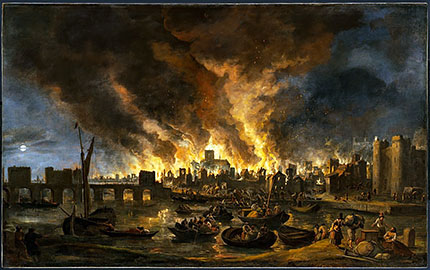
Today is the anniversary of the great fire in London.  This great fire began the night of September 2, 1666, as a small fire in the shop of King Charles II's baker.  A servant in the shop awoke at 1:00 A.M. to discover the fire, and though the baker and his family got out, the servant did not.

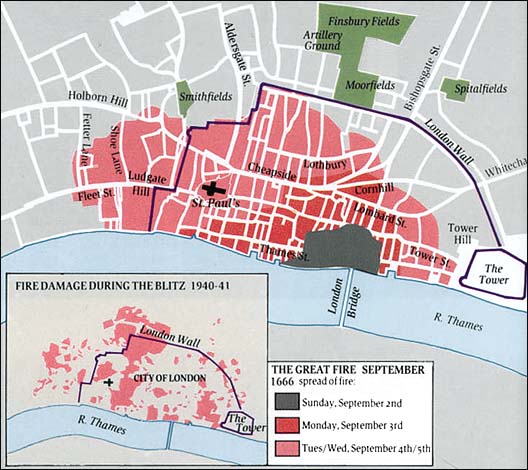
The fire spread quickly since the houses of London were made of wood and pitch. The strong winds that blew that night only made things worse.  Though the citizen fire brigade fought valiantly, by 8:00 A.M., the fire was halfway across the London Bridge.  In fact, the only thing that stopped the fire from spreading further across the bridge was the gap that had been caused by the fire of 1633.

Back then, standard procedure for stopping fires of this nature was to create fire breaks by destroying houses in the path of the fire.  Concern was raised that the cost of rebuilding might be too high, and unfortunately, the destruction of houses only pushed the fire onward.  For three days, the fire burned out of control with no relief in sight until it stopped near Temple Church.

Suddenly, it began again, and now Westminster was in danger.  The Duke of York ordered the Paper House to be demolished in order to create a fire break, and finally the fire was stopped once and for all.


Thankfully, the loss of life was minimal.  Some sources say 16, but I think others say 6 or even 4.  But this is not what staggered the city.  Four hundred thirty acres--about 80% of the main part of the city--were destroyed.  That includes 13,000 houses, 89 churches, and 52 Guild Halls (meeting place for craftsmen).  The only positive thing about this fire was the eradication of the plague of 1665.

Before the blaze, London had very narrow streets (I cannot imagine London having more narrow streets than it does now--I have been there!).  King Charles II commissioned a complete redesign of the city which included wider streets and buildings of brick.  By 1671, 9000 houses and public buildings were completed.  Then in 1675, work was begun on about 50 new churches.  There is even a commissioned monument which still on the site of the bakery where it all began.

It would seem that the fire was an accident, but since people wanted a scapegoat, the Catholics were blamed.  It was around 150 years later when the inscription that accused the Papacy of starting the fire was removed from the monument.

If you would like to see comparative pictures of the London skyline before and after the fire, click here.

Websites Used:

Related Posts Plugin for WordPress, Blogger...
Your Ad Here