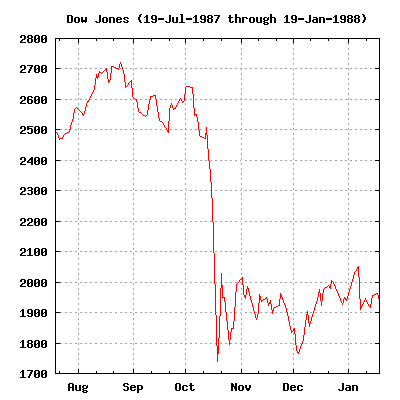
By Edward (en:Image:Black_Monday_Dow_Jones.png) [Public domain], via Wikimedia Commons
I realize this is not an uplifting feature, but it was on this date in 1987, that what has become known as Black Monday occurred. The stock markets crashed around the world. The crash started in Hong Kong and eventually made its way to the U.S. The Dow Jones dropped by 508 points. This was a record 22.6% points. I am not a financial guru, but I know that this was pretty bad. I think it is interesting to point out that financial issues are nothing new. I think we sometimes forget that.
When I saw what happened on this day, I knew I had to cover this. I have not been doing my Music Monday posts this year--I plan to get back into that--but this is a story that touches me. I always told this story with a great deal of sadness in my music classes.
These three men featured in these videos--the Big Bopper, Ritchie Valens, and Buddy Holly were tragically killed in an airplane crash on this date in 1959. They were on tour, and these three got the honor of flying on the airplane. The bus tour had been very uncomfortable, and the chartered plan was supposed to be better.
Although the weather was not the greatest, it was not a blizzard when they took off early that fateful morning. The plane crashed shortly after take-off. It was mainly pilot error since the pilot was not even a certified pilot as of yet. Of course, the pilot died as well. It was death on impact.
Indeed it was a tragedy, and I am only using this site as my resource since I have taught about this story several times. It has just been a few years since I have, so I am trying to refresh my memory.
I will end with a song that immortalized "The Day the Music Died."
A bittersweet story for today indeed. On this date in 1995, a horrible plane crash occurred. An Intercontinental Airlines plane with 52 passengers and crew aboard was flying from Bogota, Columbia to the Columbian resort city of Cartagena.
The pilot was evidently trying to make some kind of emergency landing near a swamp, but instead, for a still unknown reason, it hit a grassy field, exploded, and then fell into a lagoon. It would seem that this would have killed all people aboard.
But there is an amazing story connected with this. Nine-year-old Erika Delgado was traveling with her parents and younger brother. She told her rescuers that right before the plan broke apart, her mother shoved her out of the plane. She landed on a piece of seaweed that broke her fall. She was found by a farmer to whom she reportedly said that God had told her to stay where she was until help came. She only suffered shock and a broken arm.
Later on, she said that when she was crying out for help, someone approached her and ripped the gold necklace from her neck, her only memento from her father. Evidently looters stole things from other bodies from the crash site as well. When Erika returned to her home, she became a national celebrity and became known as "Little Miss Miracle."
I have no idea where she is now. She would be around 26 now. I can't imagine how it would have been growing up after such a trauma happened. It is indeed a story that is both amazing and sad. I hope I never experience being the sole survivor of any event.
Did you ever used to watch the Goodyear blimp as you were growing up? I was always excited to look up and see it in the sky or see it on TV. I don't know why it was fascinating to me, but it was. I can remember wanting to ride in that blimp. I don't think about blimps much these days, but this day in history concerns a terrible tragedy concerning a blimp.
Dirigibles or Airships (the real term for blimps) date back to as early as 1783. In 1785, Jean Pierre Blanchard crossed the English Channel with a balloon equipped with flapping wings and a bird-like tail. In 1852, Henri Giffard flew 17 miles in a steam-powered airship. They continued to be perfected well into the 20th century.
In the 1920's, the major European powers competed to build bigger and better blimps in order to rule the airspace. The R-101 (pictured at the beginning of this post) was Great Britain's finest achievement.It was 777 feet long, weighed 150 tons, and could carry up to 100 passengers. Six Rolls Royce engines were its source of power.
Its maiden voyage was fraught with trouble, and it was grounded for nearly a year. And it was October of 1930 when it was brought back into service. Lord Thompson was the great champion of this cause. He was one of the four passengers that day along with 52 crew members. With great anticipation of a Far Eastern destination, the blimp took of the evening of October 4, 1930. (Some sites say October 5--I wish all the sites would agree. It seems that no matter what that the crash happened on October 5.)
From the beginning, there was real trouble. The crew accidentally released four tons of water ballast that was meant to control the altitude. They also took off in a horrible storm that was over the English Channel (even though blimps were known to be dangerous during bad weather). Once the blimp reached the air over France, it was unable to keep level altitude. Because of the blackness of the night, the pilots were unaware of the danger (they were flying only 250 feet above the town of Poix). Within a very short time, the blimp began skimming the trees and then hit a small ridge. The impact instantly ignited the hydrogen supply, and 48 of the 56 were killed (though some sites say all were killed). Two men who at first were survivors later died in the hospital. There are varying numbers listed, so all I can really say is that almost all of the people on board were instantly killed.
The following video says there were 57 people aboard with 7 survivors. It is a long video, so feel free to watch portions of it or not at all. But I found it sort of interesting.