Showing posts with label financial history. Show all posts

Monday, April 22, 2013

This Day in History April 22, 1864

Longacre two cents obverse
Ever seen a two-cent piece?  I honestly didn't know there was such a thing. On this date in 1864, the first two cent piece was released with the motto "In God We Trust." This motto was new, and it was part of the U.S. Coinage Act.  But did you know that this motto was not the only one proposed?  Try "Our Trust is in God," "God Our Trust," and "God and Our Country."

For more info:
http://famousdaily.com/history/us-mints-2-cent-coin.html
http://www.essortment.com/story-american-two-cent-coin-66109.html
http://news.coinupdate.com/two-cent-piece-first-to-include-in-god-we-trust-motto-1468/
http://www.coin-collecting-guide-for-beginners.com/two-cent-coin.html

Friday, April 19, 2013

This Day in History April 19, 1933

Well, this may have been the real beginning of our continued financial woes.  On this date in 1933, President Franklin Roosevelt made the announcement that America would be suspending gold exports to other countries.  In other words, we went off the gold standard.  No longer did our money have to be backed by gold.  It devastated the value of the American dollar abroad, but it stabilized it here at home.

For more info:
http://famousdaily.com/history/us-goes-off-gold-standard.html
http://www.brainyhistory.com/events/1933/april_19_1933_91943.html
http://en.wikipedia.org/wiki/April_1933#April_19.2C_1933_.28Wednesday.29
http://www.sightm1911.com/lib/other/april19.htm

Friday, October 19, 2012

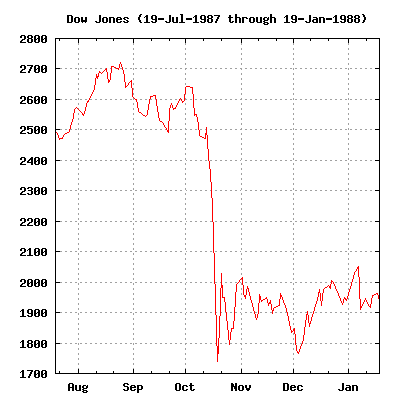
This Day in History October 19, 1987

By Edward (en:Image:Black_Monday_Dow_Jones.png) [Public domain], via Wikimedia Commons
I realize this is not an uplifting feature, but it was on this date in 1987, that what has become known as Black Monday occurred.  The stock markets crashed around the world.  The crash started in Hong Kong and eventually made its way to the U.S.  The Dow Jones dropped by 508 points.  This was a record 22.6% points.  I am not a financial guru, but I know that this was pretty bad.  I think it is interesting to point out that financial issues are nothing new.  I think we sometimes forget that.

For more information:
http://www.stock-market-crash.net/1987-crash/
http://www.answers.com/topic/black-monday
http://en.wikipedia.org/wiki/Black_Monday_(1987)
http://famousdaily.com/history/black-monday-crash.html

Friday, July 6, 2012

This Day in History July 6, 1785

I today's feature quite interesting.  It was on this date in 1785 that the U.S. unanimously chose the dollar as its monetary unit.  This does not mean that dollar bills immediately began being circulated--that took a few more years.  It was Thomas Jefferson who proposed the decimal system so that the dollars could be easily divided for change.

I am glad we have a  standard money system in this country, but I wish our dollar were more stable than it is now.  I wonder if the American dollar will ever be what it once was.  I guess until we get out of these tough economic times, that is a just a vain hope.

For more information, please check out:
http://blog.marcusstuartvannini.com/2010/07/06/july-6-historic-events-births-deaths-50-cent-louis-armstrong-william-faulkner-ak-47/
http://www.investopedia.com/financial-edge/0709/On-This-Day-In-Finance-July-6---The-United-States-Adopts-The-Dollar.aspx#axzz1zqlX2EKS
http://www.thinkfinity.org/2010-07-06_dollar-us-currency

Wednesday, January 4, 2012

This Day in History January 4, 1999


I remember this, but I had no idea that it was on this day!  It was on this date in 1999 that Europe was united for the first time since Charlemagne's reign in the 800's with a single currency--the Euro.  Eleven European Union nations (representing about 290 million people) hoped for economic growth in their countries.  The countries that adopted this country were:  Austria, Belgium, Finland, France, Germany, Ireland, Italy, Luxembourg, the Netherlands, Portugal and Spain.  The currency that was replaced was: Austrian schilling, Belgian franc, Finnish markka, French franc, German mark, Italian lira, Irish punt, Luxembourg franc, Netherlands guilder, Portugal escudo and Spanish peseta.  There were also some territories and non-EU countries that adopted this new money as well--Monaco and Vatican City, to name a few.


There was controversy, as you can imagine.  I can certainly remember that on the news.  There were concerns about inflation, counterfeiting, and other chaotic issues.  Great Britain, Sweden, and Denmark opted out of this "Euro switch."  Greece became the twelfth nation to accept this new currency in January 2001.  Even more countries joined the EU in 2004:  Cyprus, Czech Republic, Estonia, Hungary, Latvia, Lithuania, Malta, Poland, Slovakia and Slovenia.


There are now 17 countries in the so-called Eurozone, and it looks like there are some issues coming for this currency this year.  I know I had heard about that on the news, too, and I don't know what it means for the future of this currency.  I guess we will see what the future holds!


For more information, please check out these sites:
http://www.history.com/this-day-in-history
http://news.yahoo.com/eurozone-faces-tough-hurdles-early-2012-085130010.html


Related Posts Plugin for WordPress, Blogger...
Your Ad Here